2026.9.9
Ad results, and AI billed at cost
Tell Meta which ad leads booked and bought, pay for AI at what it really cost, and hand new owners a live landing page on their own subdomain.
- meta-ads
- social
- insights
- billing
- credits
- onboarding
- website
- domains
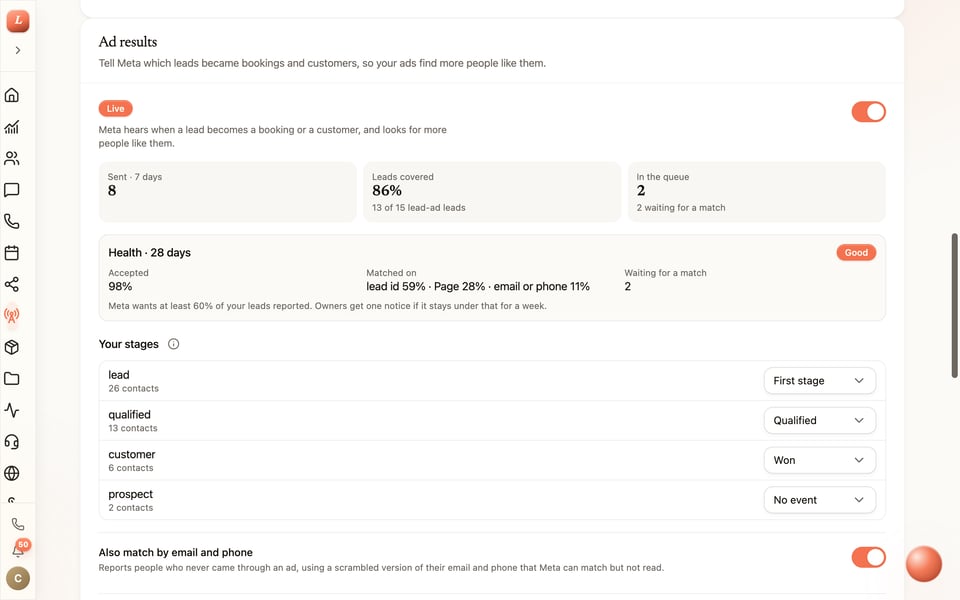
Meta only learns what happens after a click if someone tells it. Loquent now does, from the pipeline it already tracks — and it bills AI work at the price it actually paid.
Ad results
- One card, one switch — under Settings → Channels → Social, turn Ad results on, paste your dataset id and token, and prove they work with a single test event. The card is always in one of five states — Off, Setting up, Test mode, Live, Paused — so it can never contradict itself.
- Your stages, in Meta’s words — Loquent proposes what each of your pipeline stages means to an ad platform (qualified, booked, won) and you approve. Reaching a stage, or confirming an appointment, is reported as that.
- Which ads pay off — a new Ad results by ad table on Insights shows, for every ad that brought someone in, how many became leads, qualified, and booked — and the booked rate.
- Health at a glance — accept rate over the last 28 days, how events were matched, how many are still waiting, and a plain grade. If fewer than 60% of your Meta leads are being reported for a week, the owners get one notice.
- Privacy on by default — events carry Meta’s own ids only; hashed email, phone, name and address go out when you opt in. The Limited Data Use flag is set for the US states that require it.
- Stage and booking events for your own tools — a contact reaching a stage and a confirmed appointment are now events your outbound webhooks can subscribe to, so your CRM can hear them too.
AI billed at what it cost
- Real prices, not a guess — every AI request records what the provider charged. Cached input and thinking tokens are priced at their real rates instead of the full prompt rate.
- One credit pool — the four AI credit pools become one. Allowances were added together, so no organization lost balance.
- Fractions carry — a request that costs a fraction of a credit no longer rounds up. The exact charge accrues and whole credits are spent as they fill.
- Every conversation has a cost — AI usage is attributed to its conversation and contact, including memory, insights and follow-up work, so you can see what a thread cost.
Plans
- Starter is a solo plan — a plan can now carry a seat limit, and Starter is one seat. The limit holds everywhere a seat is used: the seat stepper, plan changes, and both ways of accepting an invitation.
Onboarding ends with a page
- A landing page on your subdomain — the guided setup now finishes with a link, not a script tag: a hosted page carrying the brand, catalog, hours and teammate it found, with web chat and a quote form on it. Nothing is public until you tap Publish, and running setup again leaves an existing page alone.
Your domain first
- Links lead with your domain — every hosted page lists each address it answers on, connected domain first, and Copy hands you the domain link rather than the Loquent one.
- Pick the page your domain serves at / — a dropdown on the domain row. No certificate re-issue, no DNS re-proof. “Nothing at the bare address” is a valid choice.
- Web chat on your domain — the chat bubble now works on a connected domain the same way forms and tracking already did, with no extra allowlist entry.
Under the hood
- Builds now fail on any compiler warning in either target, the lint backlog is cleared, and a watchdog restarts a hung build runner.